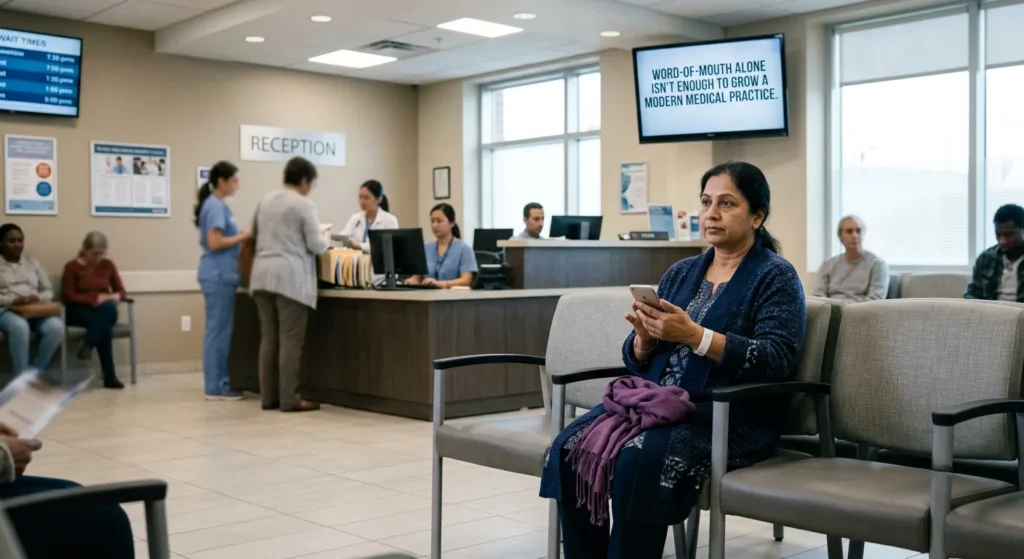
The patient who arrives through word-of-mouth is still your best patient. They are also no longer enough of them to grow a modern practice, and ignoring that fact has cost more practices their independence than almost any other single decision.
There is a story practice owners tell themselves that used to be true and is no longer. The story goes like this: deliver excellent care, treat patients well, and the practice will grow through referrals. For decades that was the right strategy and an honest one. Then, somewhere around the late 2010s, it stopped being sufficient.
The change was gradual enough that most practices missed it. The result is a generation of clinically excellent practices that are slowly being outcompeted by clinically average practices with better marketing infrastructure. The patients still talk. The referrals still happen. They just no longer move the calendar the way they used to.
Word-of-Mouth Still Produces the Best Patients
Before going further, let us be clear about what is true. A referred patient is, on almost every meaningful dimension, a better patient than an advertised patient.
They convert at a higher rate from initial contact to booked appointment. They show up more reliably. They trust the provider faster, which improves clinical engagement. They are more likely to refer others. They have higher lifetime value. Word-of-mouth is, on a per-patient basis, the most efficient acquisition channel in healthcare.
The problem is not that word-of-mouth has stopped working. It is that the conditions which made word-of-mouth alone sufficient for growth have changed.
What Changed in the Patient Journey
Three shifts in patient behavior, combined, have reduced the share of new patients who arrive through pure referral.
The first shift is verification. A patient who hears about your practice from a friend or family member used to take the recommendation and call. Today, almost without exception, that patient first searches your practice online. They read your reviews. They look at your website. They check whether your hours, location, and services match what they are looking for. If any of those check-points fails, the referral does not convert. The practice loses a patient it never knew it almost had.
The second shift is parallel research. Patients now routinely research multiple providers in parallel, even after a personal recommendation. A friend’s referral starts the journey but rarely ends it. The patient compares the recommended practice against competitors, often based on factors the referral source never mentioned.
The third shift is digital intermediation. Many patients no longer ask friends and family for recommendations as a first step. They search. The trusted-friend layer that used to drive a substantial share of referrals has been partially replaced by Google, review platforms, and aggregator sites. A practice that does not appear in those searches is invisible to a growing share of its potential patient base, regardless of how strong its real-world reputation is.
Why This Matters More Now Than Five Years Ago
Two additional factors have accelerated the trend.
Competitive density has increased. In most metropolitan markets, the number of practices in any given specialty has grown faster than the patient population. That means each practice’s share of available demand is smaller, and the share captured through word-of-mouth alone has thinned correspondingly.
Patient mobility has increased. People relocate more often. They change insurance more often. They lose the long-tenured relationships with established practices that used to anchor referral networks. Each new arrival in a market starts their healthcare search from scratch, and that search is digital by default.
The Visible Symptom
Practices that are leaning entirely on word-of-mouth often show a particular pattern. Patient volume is stable or slowly declining. Patient acquisition cost is reported as essentially zero because no formal marketing is being done. The owner is proud of this. The calendar is also gradually emptying, but the decline is slow enough that the connection is not made for several years.
By the time the pattern becomes visible at the P&L level, the practice has often lost meaningful market position. Building marketing infrastructure from scratch under financial pressure is harder than building it from a position of stability, which is the reason the most resilient practices begin investing before they need to.
What Word-of-Mouth Needs in 2026
The good news is that word-of-mouth is not being replaced by digital marketing. It is being amplified by it. A practice with strong referrals and good digital infrastructure grows faster than a practice with either alone.
The infrastructure that lets word-of-mouth do its job in a modern market is straightforward in principle.
A website that loads quickly, presents the practice clearly, and converts visitors who arrive after hearing the practice name from a friend. This is the most common failure point. A patient hears about a practice, searches its name, lands on a slow or confusing site, and quietly disqualifies it. Word-of-mouth without a working site is a leaky bucket.
Search visibility for branded queries. When a patient searches the practice name, the practice should appear first, with its Google Business Profile populated, reviews visible, and key information immediately accessible. This is not difficult to set up. Many practices simply have never done it.
Active review management. Patients who are happy enough to refer a friend are usually willing to leave a review if asked. Most practices do not ask systematically. A simple post-visit review request, done with appropriate compliance considerations, can transform a practice’s online reputation in months.
A response system that catches referred patients quickly. A patient who calls after hearing about the practice from a friend has high intent but limited patience. If the call goes to voicemail and is returned forty-eight hours later, the referral leaks. The fastest, simplest infrastructure improvement is making sure those calls connect to a human in real time.
The Practical Sequence
Practices that decide to add infrastructure around their word-of-mouth do not need to rebuild everything at once. The sequence that has worked most consistently is to start with the assets that catch existing referrals — site conversion, branded search visibility, review collection, response capacity — before adding outbound acquisition.
This sequence has two advantages. It captures revenue that was already on the table but leaking, which improves the practice’s financial position. And it strengthens the foundation that any later outbound marketing will route patients through, so when outbound spend does begin, more of it converts.
The objective is not to replace word-of-mouth. It is to make sure the word-of-mouth a practice has worked years to earn actually translates into patients in the calendar.