GoHighLevel is among the most flexible and most carelessly deployed CRM platforms in healthcare marketing. The flexibility is the opportunity. The carelessness is where most implementations go wrong.
GoHighLevel — commonly abbreviated as GHL — has become a default CRM platform for a growing share of medical practices, particularly med spas, aesthetic clinics, and solo or small-group practices that want unified marketing and intake infrastructure without enterprise-tier pricing. The platform’s combination of CRM, marketing automation, SMS, email, calendar integration, and pipeline management addresses most of the operational needs a small practice has from a single interface.
It is also a platform whose flexibility means it is frequently set up in ways that produce avoidable problems. The same configurability that lets a thoughtful implementer build a powerful patient pipeline lets a careless implementer build one that ignores compliance, drops leads silently, or creates technical debt that is hard to fix later. The platform’s reputation among practice owners often depends less on the platform itself than on who set it up.
A practical guide to GHL for healthcare is less about platform features and more about the implementation choices that determine whether the deployment works as intended.
What GHL Does Well for Medical Practices
The platform’s core strengths are real and worth naming.
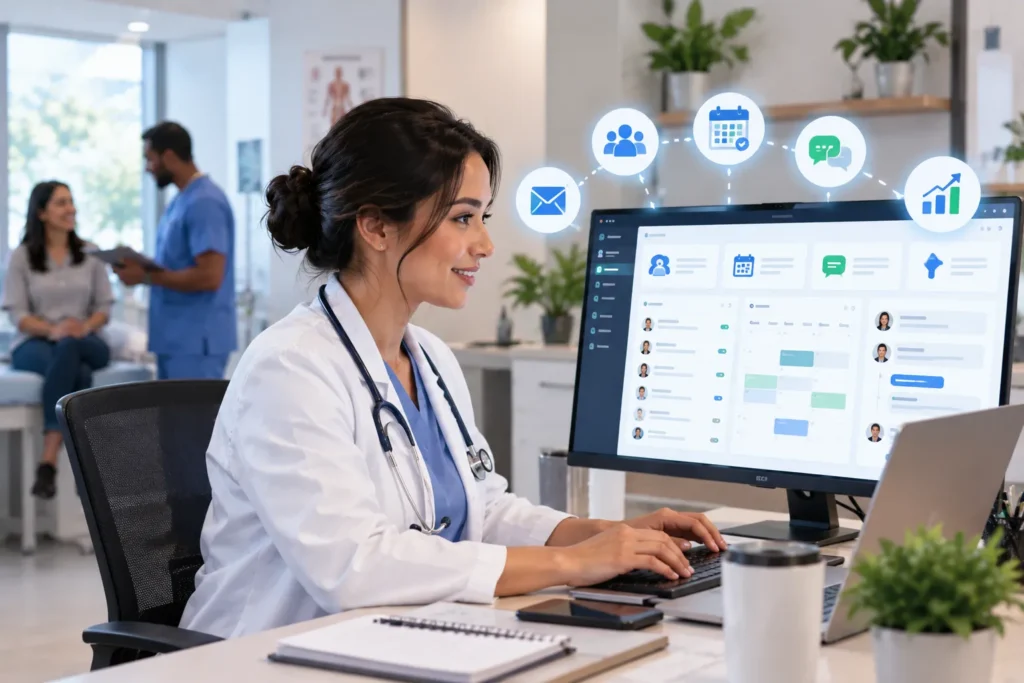
Unified inbox handling — phone calls, SMS, email, web chat, and form submissions all arriving in a single conversation thread per patient — eliminates the lost-in-the-seams problem that plagues practices running separate tools for each channel. A lead that called yesterday and texted today appears as one conversation rather than as two unrelated events.
Pipeline management with stages aligned to the practice’s actual intake process lets the team see at a glance which leads are at which stage. A lead waiting for a first call, a lead in the qualifying conversation, a lead scheduled for consultation, and a lead scheduled for treatment can each occupy a distinct visible position in the workflow.
Automated workflows that fire on specific triggers — a new lead arrives, a confirmation is sent, an appointment is booked, a no-show occurs — allow practices to standardize the response patterns that would otherwise depend on individual staff remembering each step. Once configured well, the automation handles the consistency that human attention often misses.
Calendar integration that handles online booking, reminder sequences, and follow-up — closing the loop between marketing inquiries and clinical scheduling — reduces the manual handoffs that introduce delay and error in many practices.
The BAA Question
Before any setup work, the foundational question for healthcare GHL deployments is the Business Associate Agreement. The platform offers BAA coverage on appropriate tiers and accounts, but the BAA must be executed explicitly. It is not automatic with any account, and many practices operating on GHL have never actually executed one.
Practices using GHL without an executed BAA are operating outside the compliance posture they likely assume they have. Patient identifiers, communication content, and intake data flowing through the platform are PHI under the configurations most healthcare practices use, and the BAA is the prerequisite that makes the data flow appropriate.
The action item before any other GHL configuration work is to verify that a BAA has been executed and that the account is on a tier that includes BAA coverage. Without that foundation, the rest of the implementation is being built on a problematic base.
Pipeline Architecture
The pipeline stages defined in GHL determine how the practice will see and manage its patient flow. Generic pipelines copied from non-healthcare templates almost never fit. A working pipeline for a medical practice typically reflects specific clinical and operational realities.
A reasonable starting structure for many specialties includes stages for new lead (just submitted, not yet contacted), in qualification (first contact made, gathering information), consultation scheduled, consultation completed, treatment scheduled, treatment completed, and follow-up. Practices with longer consideration cycles may add stages for nurture and re-engagement. Practices with specific procedure pathways may add stages for pre-procedure work and post-procedure follow-up.
The stages should reflect transitions that the practice can actually observe and act on. Stages that exist for organizational tidiness but never get used in practice produce reporting noise. Stages that genuinely capture meaningful transitions produce reporting that informs operational decisions.
Automation Boundaries
GHL’s automation capabilities are powerful enough to be dangerous if applied without restraint. The temptation is to automate everything — every confirmation, every reminder, every follow-up, every escalation. The risk is that excessive automation produces communication that feels mechanical, hits patients with more messages than they want, or fires inappropriately in edge cases.
Effective automation tends to be more conservative than the platform’s capabilities encourage. Confirmations of action — “we received your inquiry,” “your appointment is confirmed,” “you have a visit tomorrow” — are reliably useful. Long sequences of marketing-style nurture messages to people in the middle of a clinical decision often feel intrusive. The line between helpful automation and harassment is subjective but real, and patients notice when it is crossed.
Frequency caps and unsubscribe handling deserve explicit attention. A patient who has expressed any preference to communicate less should not be receiving the full automation sequence. GHL supports the controls needed to honor these preferences; the configuration to apply them must be set up deliberately.
SMS Configuration
GHL’s SMS capabilities are one of its most valuable features and one of the most commonly misconfigured. Several specific configurations matter for healthcare.
Consent capture at the lead-form level — explicit opt-in to SMS communications, separate from any general marketing consent — should be in place before any SMS triggers are activated. Sending SMS without explicit consent creates both compliance issues and patient experience problems.
Opt-out handling — the standard STOP keyword and any platform-specific opt-out triggers — must be honored across the entire account. A patient who opted out of SMS in one workflow should not continue to receive SMS from other workflows. GHL supports this, but the configuration must be set up to apply opt-outs globally.
Message timing — when SMS messages can and cannot be sent — should reflect both legal requirements and patient experience. Sending automated SMS at three in the morning, even technically permitted, produces patient frustration that the practice will pay for in other ways.
Phone number assignment — whether SMS comes from a local number, a toll-free number, or a short code — affects deliverability and patient perception. Local numbers generally produce better engagement for local practices than toll-free numbers do.
Form and Funnel Integration
GHL allows building forms and funnels directly within the platform. Whether to use them depends on the practice’s broader site architecture.
For practices whose main website lives on another platform — WordPress, Webflow, or a custom build — the most common pattern is to route forms from the main site into GHL via integration rather than to use GHL-hosted forms. This keeps the patient experience consistent on the main site while routing data into the CRM appropriately.
For practices that use GHL more comprehensively, including hosting landing pages directly in the platform, the integrated approach can work but introduces design and SEO constraints. GHL’s funnel builder is more limited than dedicated tools, and pages hosted there typically perform less well on SEO than pages on a properly built website.
A common pattern that works well is using the main website for organic and SEO-driven content while using GHL for paid-traffic landing pages where speed of iteration matters more than long-term SEO authority. The two surfaces serve different purposes and complement each other.
Integration With Other Systems
GHL integrates with most of the systems a medical practice already uses — Google Ads, Meta, call tracking platforms, email providers, scheduling systems, and EHRs through various integration paths. Most of these integrations work, but each requires explicit configuration and ongoing attention.
The integration with Google Ads conversion tracking, in particular, deserves careful attention. The default integration patterns may transmit data to Google in ways that need to be reviewed against the compliance considerations addressed elsewhere in this series. Server-side configurations, parameter filtering, and BAA-conscious architecture all apply to GHL-Google integrations as much as to any other configuration.
EHR integration is often the most complex piece. Different EHRs offer different integration paths, and the integration between GHL and the EHR — if any — determines whether the marketing-side data and the clinical-side data remain connected. Practices serious about closed-loop reporting eventually need this integration; it is worth scoping it explicitly during setup rather than treating it as an afterthought.
What Goes Wrong Most Often
Reviewing GHL implementations across medical practices reveals consistent failure patterns. Pipelines copied from generic templates that do not match the practice’s actual workflow. Automation sequences that fire excessively and produce patient complaints. SMS sent without proper consent capture. BAAs missing entirely. Integration with Google Ads transmitting more data than appropriate. Old workflows from previous configurations still firing in the background.
Each of these is fixable. None of them are the platform’s fault. They reflect implementations that were started quickly and never properly audited. A practice on GHL with persistent operational issues should audit the implementation before assuming the platform is the problem.
Done well, GHL produces a unified patient acquisition operation that small medical practices struggle to match with separate tools. Done carelessly, it produces a single point of failure with broader implications than any of the individual tools it replaced.