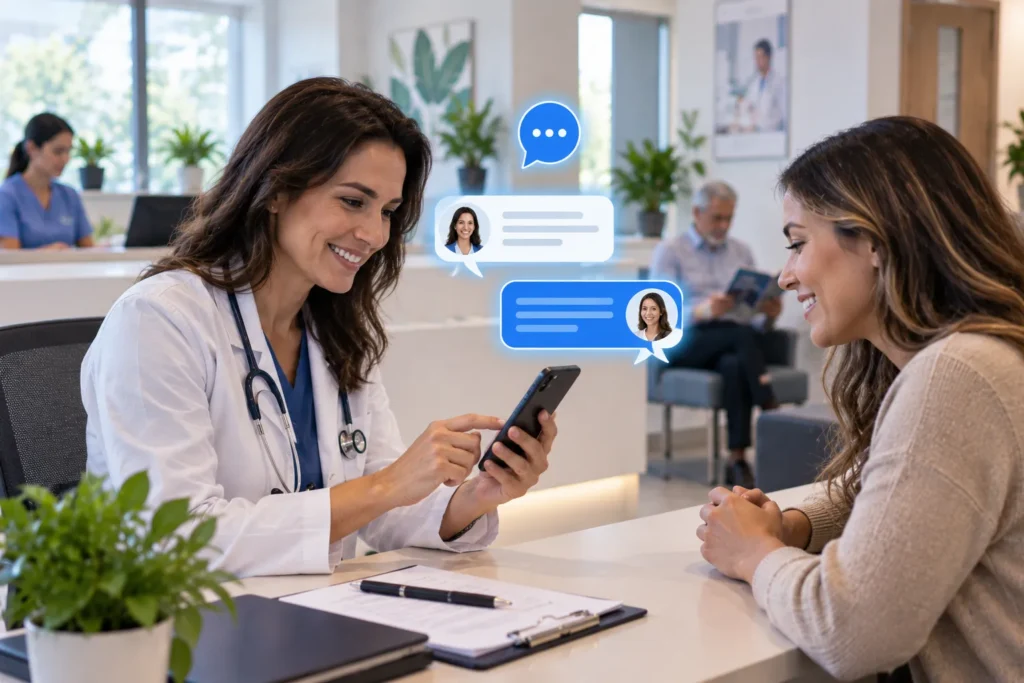
Patients answer text messages. They do not answer most other things. Treating text as a conversation rather than a broadcast is the difference between a tool that converts and a tool that annoys.
The most consequential change in healthcare patient communication over the past several years is not a new technology. It is a behavioral shift. Patients increasingly prefer text-based conversations with their providers and the staff who support them. They will text. They often will not call, will not check email promptly, and will not engage with portal messages in a timely way. The channel they actually use is the one they already use for everything else in their lives.
Practices that recognize this and configure their systems for actual two-way text conversations — not just automated reminders flowing one direction — see meaningful improvements in patient responsiveness, intake conversion, and overall satisfaction. The challenge is that two-way texting introduces operational and compliance considerations that one-way SMS blasts do not, and most practices have not built the infrastructure or training to handle them well.
What Two-Way Texting Actually Is
Two-way texting is conversational text-based communication between the practice and the patient where both sides can initiate, respond, and continue the exchange. The patient can text the practice with a question and receive a real response from a real person. The practice can text the patient and the patient’s reply lands in front of a human who can engage with it.
This is different from automated SMS workflows where the practice sends messages and the patient is, at most, allowed to reply with a single keyword like STOP or YES. Two-way texting means actual conversation, with the same back-and-forth that the patient would have over the phone or in person, conducted through SMS as the medium.
The infrastructure required is meaningfully more substantial than what one-way SMS requires. A platform that can handle inbound messages, route them to appropriate staff, maintain conversation threads, store the exchange appropriately, and integrate with the CRM is the foundation. Staff trained to handle text conversations, with response time expectations and quality standards appropriate to the medium, is the operational layer.
Where Two-Way Texting Produces the Most Value
Several specific use cases tend to produce disproportionate value from two-way texting.
Lead qualification. A new lead who has submitted interest can be engaged through text by the intake team. Patients who are reluctant to take a phone call from an unknown number — which is most of them — frequently respond promptly to a text. The qualification conversation that would have taken multiple voicemail-tag attempts happens in a few exchanges over an hour.
Scheduling logistics. Patients confirming, rescheduling, or asking questions about appointments interact more efficiently through text than through phone calls. A short exchange that would consume ten minutes by phone happens in two minutes by text, with both sides able to fit it into their other activities.
Pre-visit and post-visit communication. Questions about preparation, reminders of what to bring, post-visit follow-up, and clarification of instructions all fit text conversations naturally. The medium is asynchronous, which respects the patient’s schedule, but immediate enough that questions get answered rather than postponed indefinitely.
Reactivation engagement, when consent and infrastructure support it. Dormant patients who would not respond to phone calls or email sometimes respond to a personal-feeling text from the practice. The reactivation considerations from elsewhere in this cluster apply.
The Compliance Layer
Two-way texting touches several compliance frameworks that apply more demandingly than they apply to one-way automated messages.
The platform handling the conversations must operate under BAA coverage. Text conversations between a medical practice and a patient routinely contain identifiable information and often contain clinical context. The platform storing, transmitting, and managing those conversations is processing PHI.
Consent considerations apply. The TCPA framework that governs SMS consent applies to two-way exchanges, including the patient’s initial consent to receive texts from the practice. Patients who text the practice without prior consent are typically considered to have provided implied consent for the immediate response, but ongoing communication beyond the immediate exchange should ideally be supported by explicit consent.
Content considerations apply. The same principle that applies to one-way SMS — that protected health information should not appear in non-secure channels — applies more strongly to two-way exchanges where staff may be tempted to discuss clinical details that fit the conversational flow. Training matters here; staff handling text conversations need to know what belongs in text and what should be moved to a secure channel.
Documentation considerations apply. Text conversations with patients are part of the patient communication record and need to be retained, accessible, and produced in appropriate circumstances. The retention policy applied to text conversations should reflect the same considerations that apply to other patient communications.
Operational Design
Several operational design choices determine whether two-way texting works well or poorly.
Response time expectations should be set explicitly. Patients texting the practice generally expect responses faster than they would expect from email, slower than they would expect from a live phone call. A typical operational target is responses within an hour during business hours, with clearly communicated unavailability outside those hours.
Routing of inbound texts should connect to a person who can actually respond, not to a queue that gets processed once a day. The fast response that makes texting valuable to patients depends on staff actually being available to respond at the pace the medium implies.
Conversation handoffs need to work cleanly. A patient texting a scheduling question may need their conversation routed to a clinical staff member. A patient texting a clinical question may need to be redirected to an appropriate channel. The platform should support these handoffs without forcing the patient to start over.
Off-hours behavior should be designed deliberately. Practices that allow texting during business hours but do not handle off-hours messages need to communicate this clearly. An automated response after hours that acknowledges the message and sets expectations for when a human will reply is meaningfully better than silence.
Tone and Quality Standards
The conversational quality of text exchanges affects patient impressions of the practice in ways that one-way SMS does not.
Text conversations should feel professional but personal. The staff member texting should write as themselves, not in stilted corporate language. Patients respond differently to messages that feel human than to messages that feel scripted.
Brevity matters. Long text messages get read incompletely or not at all. Effective text communication tends toward short, focused messages that convey one thing clearly and invite a response if more information is needed.
Errors matter. Typos, autocorrect mistakes, and unclear phrasing affect patient impressions more than the same errors would affect impressions of email. Staff handling text conversations benefit from reviewing messages before sending, even at the cost of slightly slower response.
Tone calibration matters. Different patients prefer different conversational styles. Staff who can read the patient’s style from early exchanges and match it produce better conversations than staff who use the same approach with everyone.
Where Two-Way Texting Becomes Inappropriate
Despite the benefits, several types of communication should not happen through text.
Discussions of detailed clinical information, test results, treatment recommendations, or anything that requires secure transmission belongs in HIPAA-secure patient portals, not in SMS. The convenience of text does not override the security considerations.
Sensitive conversations about diagnoses, prognoses, or other emotionally significant topics generally do not belong in text. The medium is too brief and too informal for the gravity of the conversation, and the asynchronous nature can leave patients waiting for responses to important questions in ways that produce anxiety.
Urgent clinical situations require channels that ensure real-time response. Text messages can be missed, delayed, or read out of sequence in ways that are dangerous when the underlying situation is time-critical. Patients in acute distress should be directed to appropriate emergency channels, not engaged through text.
Practices using two-way texting should train staff to recognize when a conversation has moved outside what text is appropriate for and to redirect to the right channel quickly. The redirection itself needs to be handled well — abrupt termination of a text conversation feels worse than a smooth transition to a phone call or portal message.
The Operational Investment
Two-way texting is not free to implement. It requires platform investment, staff training, and ongoing attention to the quality of conversations. The benefits — improved patient responsiveness, better intake conversion, higher patient satisfaction — are real, but they come from sustained operational discipline rather than from turning on a platform feature.
Practices that invest in doing it well see results that justify the investment. Practices that turn on texting capability without the operational layer underneath tend to find that patients send messages that go unanswered, which produces frustration that one-way reminders alone never created.